Fall changes inside a single day. A morning that needs three layers becomes an afternoon that needs one. It also changes by where you are: an office at a fixed temperature, a platform in the wind and a restaurant after dark are three climates in one evening.
This is a formula guide rather than a shopping list. Nothing below names a product.
Petite is a size range, not a set of proportions everyone in it shares. Two people who both buy petite can need opposite things from the same coat. So none of the formulas below corrects anything. They assemble.
What makes fall harder than the other seasons is that a garment stops being judged on its own: a knit that fits can be the reason a jacket will not close. A product page describes one garment alone.
Read the weather before the outfit
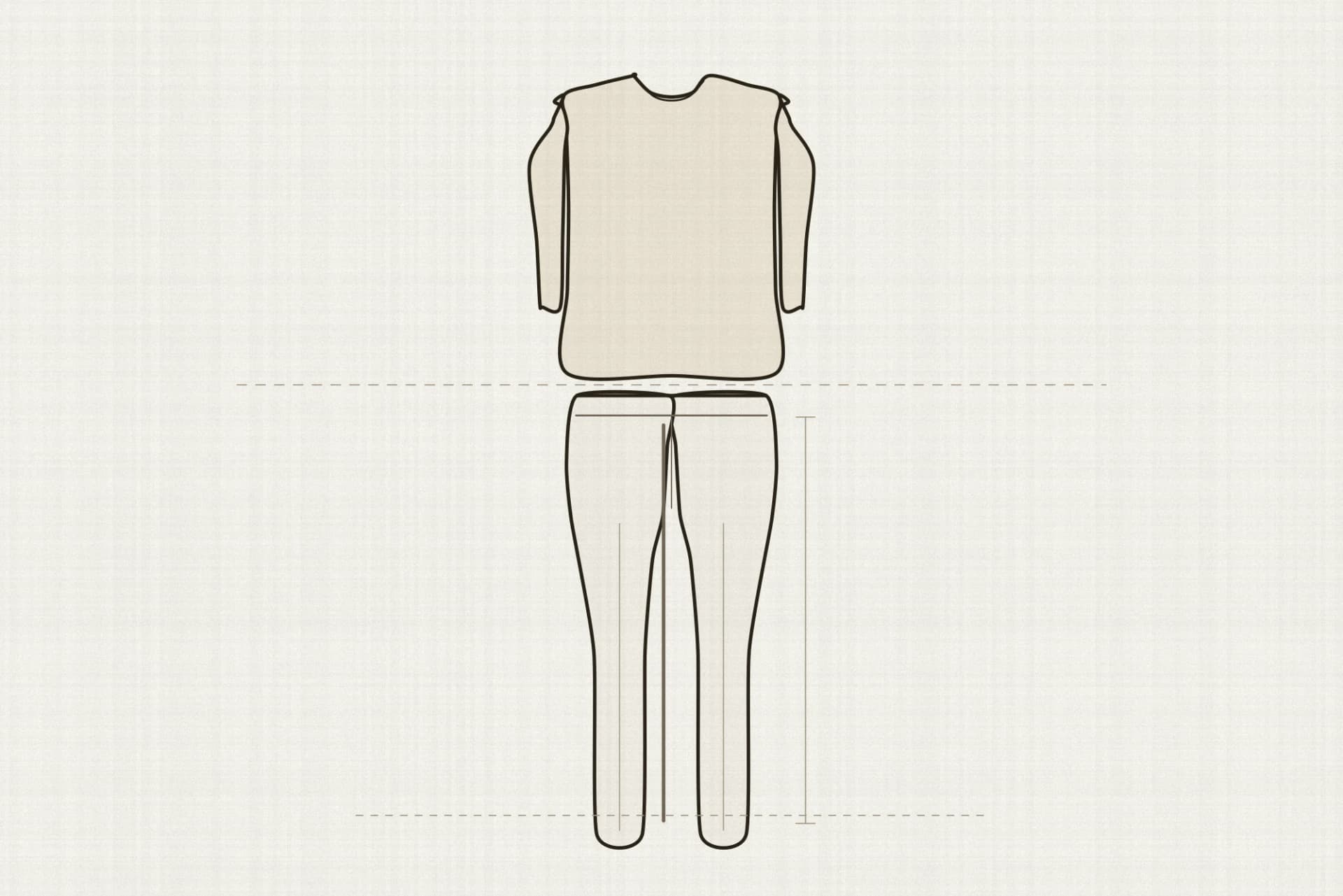
A fall stack is easier to think about when garments are sorted by what they are for. This guide separates three functions: a layer nearest the body, a layer added for warmth, and an outer layer chosen for the conditions. One garment may serve more than one function; the label records its primary job in this stack.
The base layer sits nearest the body. Its job is comfort for the length of the day, and its second job is to set how much room the next layer needs. A fine shirt and a heavy one occupy different amounts of space.
The insulation layer is the knit, cardigan, sweatshirt or vest. Its job is warmth. An insulation layer can expose a compatibility problem even when each garment works separately, because it changes the room required at the chest, armhole, sleeve and closure.
The weather layer is the jacket, trench or coat. It has to close and move over everything beneath it. This guide treats a weather function as established only where the garment’s own page states it, and a style name is not a construction statement.
The checks that apply before every formula
The same list sits behind all ten.
- The occasion, and any dress code it carries.
- The temperature range across the whole day, not when you leave.
- How much of the day is indoors and how much outdoors.
- The silhouette you want, stated before you start.
- A garment you own that works, to compare against.
- What is going underneath each layer.
- The measurements you can get, and where each is taken from.
- Whether the outer layer closes and moves over the whole stack.
- The hem and shoe relationship, and what the page left open.
Two of those carry the rest. A comparison garment settles what a chart cannot: whether this fits you. And a measurement without its origin cannot be compared, since a length from the shoulder point and one from the back neck are different distances on the same garment. The Inseam Map works through what that costs.
Ten petite fall outfit formulas
Each carries its conditions, its stack, its checks and what stays unresolved. They are numbered for reference rather than ranked.
Formula 1 of 10Cool morning, warm afternoon
The stack
- A light base layer
- A fine knit or cardigan that comes off in one movement
- A trouser or denim you can sit in
- A closed shoe
The outfit is built around one garment leaving at midday, so the base layer has to work alone and the middle layer has to come off cleanly.
Check before wearing these together
- Room under the middle layer, checked with the base layer on.
- Whether the base sleeve stays put when the middle sleeve comes off over it.
- Whether the removed layer can be carried or fits your bag.
What can stay unresolved
How warm either layer is. No page in the sample below states it, and a fibre content does not settle it.
- If it is warmer
- Start with the middle layer in the bag and treat the base layer as the outfit.
- If it is colder
- Add a weather layer over the pair, so the removable garment stays removable.
Formula 2 of 10Casual weekend
The stack
- A tee or fine knit
- Denim or a casual trouser
- An overshirt or a short jacket
- A shoe chosen for the distance you are walking
The top layer does a light warmth job and a finishing job at once, so the room it was drafted with is the thing to read.
Check before wearing these together
- The looseness the top layer is meant to have, in the brand’s own words rather than the photograph.
- Rise, leg shape and inseam read together, since changing one moves the hem.
- Whether the jacket closes over the base layer, and whether the shoe suits the ground.
What can stay unresolved
How a relaxed or oversized garment will sit on you. The word describes the drafting, not the result.
- If it is warmer
- Drop the outer layer and let the fine knit finish the outfit.
- If it is colder
- Put the overshirt under a weather layer, where it becomes the insulation layer.
Formula 3 of 10A workday with a structured layer
The stack
- A shirt, shell or fine knit
- A trouser or skirt for the dress code
- A blazer
- A shoe you can be on your feet in
A blazer’s fit is decided by construction rather than measurement alone, and the layer underneath decides whether that construction still works.
Check before wearing these together
- The shoulder construction, and chest and armhole room with the intended layer beneath rather than a bare shirt.
- The sleeve figure, and the point the page says it is measured from.
- Whether it closes, if you wear it closed, and the temperature of the room you will spend the day in.
What can stay unresolved
Shoulder width, which a structured jacket turns on and which no page in the sample below publishes.
- If it is warmer
- Swap the knit for a shell and carry the blazer rather than wearing it.
- If it is colder
- Add a weather layer sized to go over the blazer, not a knit sized to go under it.
Formula 4 of 10A rainy commute
The stack
- A base layer you will be wearing indoors for much of the day
- A lower layer you can arrive damp in
- An outer layer that states what it does about water
- A closed shoe
Rain is handled by construction, and construction is either stated on the page or not established.
Check before wearing these together
- The exact water-resistance wording, if any. Resistant and proof are different claims.
- Whether you have a hood or an umbrella, decided before you leave.
- How much hem is exposed below the outer layer, which gets wet first.
- That the layer you are left in indoors works all day, and that the outer layer still closes over the stack.
What can stay unresolved
Whether an ordinary coat keeps rain out. A coat can be lined, well made and silent on the subject.
- If it is warmer
- Drop the insulation layer and let the outer layer work alone.
- If it is colder
- Add insulation underneath only if the outer layer has room for it, and check the closure first.
Formula 5 of 10A dress with a removable layer
The stack
- A dress or jumpsuit
- A cardigan, blazer or short jacket over it
- A weather layer if the conditions need one
- A shoe chosen with the hem in mind
A one-piece settles the silhouette in one decision, and works with a waist and length you cannot move.
Check before wearing these together
- Where the waist sits, and whether the layer over it leaves that line alone.
- The total length, and where the page says it is measured from.
- Sleeve and armhole compatibility, especially a knitted sleeve under a set-in one.
- Whether the outer layer closes over the fullest part, and where the hem sits against the shoe.
What can stay unresolved
What a published length means with no measuring point. Two dresses printed at the same number can end in different places.
- If it is warmer
- Wear the dress alone and carry the layer.
- If it is colder
- Add tights or a heavier base, then recheck that the outer layer still closes.
Formula 6 of 10A skirt with a knit
The stack
- A fine knit or shirt
- A skirt
- A jacket if the day needs one
- Tights or a bare leg, according to the weather
- A shoe chosen with the hem in mind
The problem is the waistband, where two garments compete for the same few centimetres. Everything else follows from how much fabric gathers there.
Check before wearing these together
- Where the skirt waist is meant to sit, and the body length of the knit, which decides whether it tucks, sits on the waistband or covers it.
- How much bulk collects once the knit is in position, and whether the closure still fastens.
- The hem and shoe relationship, and whether tights change it.
What can stay unresolved
Knit body length. One of the two knits in the sample below publishes a length and neither names a point it is measured from.
- If it is warmer
- Drop the jacket and leave the knit as the only upper layer.
- If it is colder
- Move to a heavier knit and recheck the waistband, since bulk manageable at fine gauge may not be.
Formula 7 of 10A longer outer layer
The stack
- A base outfit you know works
- A longer jacket, trench or coat over the whole of it
A longer coat is a silhouette, not a petite fit error. Its usefulness depends on the garment, the stack and what you need it to do. The length changes how much construction the coat has to get right.
Check before wearing these together
- Shoulder construction, which carries more weight on a long coat than a short one.
- The sleeve and body length figures, and the points they are measured from.
- Whether it closes over the complete stack rather than a shirt.
- Vent and lining, how it moves when you sit, and what the page says about weather.
What can stay unresolved
Everything above the hem. Of the two coats sampled below, one publishes a body length and one none, and neither names an origin.
- If it is warmer
- Wear it open over a lighter stack and let it block wind and nothing else.
- If it is colder
- Add the insulation layer under it only if it still closes over the result.
Formula 8 of 10A travel day
The stack
- A comfortable base layer
- A lower layer for hours of sitting
- A removable knit
- An outer layer
- A shoe for the walking and weather you planned
A travel outfit crosses several climates in one day and is worn seated for much of it, so the stack has to come apart in a confined space.
Check before wearing these together
- Whether the lower layer is comfortable seated, a different question from whether it fits.
- How many temperature changes you are crossing, and whether pockets work under a bag strap.
- Care and wrinkle information where the page states it, and unknown where it does not.
- That the knit comes off without the outer layer or bag coming off first.
What can stay unresolved
How anything behaves after six hours in a seat. No page in the sample below states it, and a garment you have already travelled in is the comparison available to you.
- If it is warmer
- Leave the knit in the bag and keep the outer layer for the terminal.
- If it is colder
- Keep the knit on and allow room to spare rather than relying on a coat that only just closes.
Formula 9 of 10Dinner or an evening out
The stack
- A base layer or one-piece garment
- An outer layer chosen rather than defaulted to
- A shoe for the venue and the walking either side
The outer layer comes off, so this is two outfits: the one that arrives and the one that sits down.
Check before wearing these together
- What you are wearing after the coat is off, judged on its own.
- Whether the coat closes over it, and how the hem sits against the shoe.
- How much colder it will be going home.
What can stay unresolved
The temperature of the venue, which is why the layer that comes off should be one you are comfortable in and without.
- If it is warmer
- Reduce the outer layer to something light and treat it as wind protection.
- If it is colder
- Add a base layer under the one-piece rather than a bulkier coat over it.
Formula 10 of 10The first genuinely cold day
The stack
- A base layer
- An insulation layer
- A weather layer over both
- A lower layer suited to the conditions
- A closed shoe or boot for the ground
The day the full stack goes on. Nothing is new except that three upper garments now occupy the same space.
Check before wearing these together
- Chest and armhole room, checked with the complete stack on rather than one garment at a time.
- How the three sleeves stack, and whether the innermost rides up when the outermost goes on.
- Whether the outer layer closes over all of it, and how the neck and cuffs interact.
- Whether you can walk, reach and sit in the result.
- Whether a warmth claim you rely on is one the page made or one you assumed.
What can stay unresolved
Whether the stack is warm enough. Warmth is a property of the whole assembly against the actual conditions, and no single page establishes it.
- If it is warmer
- Drop the insulation layer and keep the weather layer.
- If it is colder
- Add warmth at the base and the extremities rather than the middle, where the closure is tightest.
How to adapt a formula without turning it into a rule
These are the substitutions that keep a formula intact, and the assumptions that break one.
- Not every layer has to come from a petite range. Petite and regular can be mixed by garment category where the published measurements and construction meet your requirements.
- A relaxed garment is drafted with room in it, not a fitted garment that went wrong.
- A cropped garment is not automatically more suitable, and a longer one is not automatically unsuitable.
- One verified garment can anchor a stack, because everything else compares against it.
- A formula can be adapted around a skirt, trouser or one-piece garment, but relevant checks may change, including waist placement, rise, closure, layer length and the hem-and-shoe relationship.
- Changing the layer underneath can change the size you need above it, so buy the outer layer last.
- A figure the page did not publish stays unknown, and uncertainty does not become evidence by being inconvenient.
The mixing point rests on several ranges’ published sizing: petite on the bottom and regular on top is a strategy rather than a workaround. What it depends on is what a brand’s petite designation changed, which petite range or petite block sets out, and the Petite Fit hub collects what is settled.
What current official pages publish before a fall outfit is assembled
The checks above are only worth running if the information exists. Below is a dated sample of ten official pages read in a browser on one day: a base layer, two middle layers, two coats, three trousers and two one-piece garments across four brands. It is a sample and not a survey.
What these pages publish before a layer is added
Ten official pages read on one day, ordered by the job each garment does in a stack rather than by anything about the garments themselves. The order carries no ranking and no preference.
Base layer
White House Black Market
Petite Button Front Collared Shirt
- “Modern, effortless fit”A petite length and a regular length, labelled as such in one field structure on the page
- “Length”, given once for petite and once for regular“Petite length: 24 5/8”” beside “Regular length: 26””Not established
- Long sleeves, collar neck, button front, 96% viscose and 4% linenNot established
- No chest, no shoulder and no sleeve figure, which are the three that would settle whether a middle layer closes over this one. What the two lengths differ by is a difference between two of the brand’s own numbers, not a distance on a wearer.
Insulation layer
J.Crew
Cable-knit cardigan in merino wool blend, read with the control showing Petite
- “Classic fit”Not established
- Not establishedNot establishedNot established
- 98% merino wool, 1% elastane and 1% other fibresNot established
- Everything a stack turns on. No body length, no sleeve length, no chest and no armhole, so whether this passes under a jacket sleeve can only be settled against a garment already owned. Nothing states what differs between the size ranges this one address serves.
Insulation layer
White House Black Market
Petite Pointelle Knit Puff Sleeve Pullover
- “Modern, effortless fit”A petite length and a regular length, labelled as such in one field structure on the page
- “Length”, given once for petite and once for regular“Petite length: 22 1/2”” beside “Regular length: 23””Not established
- Elbow sleeves, notch neck with ties, 55% cotton, 39% polyester and 6% nylonNot established
- The sleeve is given as a type rather than a figure, which is the field that decides whether an outer sleeve has anything to pass over. The two published lengths sit closer together than on any other page in this sample, and that is a fact about two of one brand’s numbers rather than about any body.
Weather layer
J.Crew
Petite new Icon trench coat, read with the control showing Petite
- “Relaxed fit”Not established
- “Sleeve length”30″Not established
- Not establishedNot established
- No body length at all, so the only length statement is “Hits below knee”, which is a description. No chest, no shoulder, no armhole. Nothing establishes that this garment keeps water out, and nothing about a stack fitting under it.
Weather layer
J.Crew
Petite Chiara topcoat in Italian double face, read with the control showing Petite
- “Relaxed fit”Not established
- “Body length” and “Sleeve length”43 3/4″ body length, with a 30 1/2″ sleeveNot established
- Not establishedNot established
- What either figure spans. Read beside the trench above it, this row shows one brand printing a body length on one coat and none on another, with the same silhouette word and the same descriptive hem position on both.
Lower layer
J.Crew
Petite Luna pant in lightweight corduroy, read with the control showing Petite
- “Relaxed through the hip, thigh and leg”Not established
- “Inseam”, alongside a rise given as “12 1/4” mid-rise”23″ inseamNot established
- Not establishedNot established
- Where the hem lands on a wearer. The page pairs the figure with an intended position, “designed to hit above the ankle”, and that pairing is useful and is still a description rather than a second measurement.
Lower layer
White House Black Market
Petite Pleated Wide Leg Pant
- “Relaxed through hips + thighs”, with a rise given as “High rise”A petite inseam printed beside a regular one, with two further regular-range lengths named short and long
- “Inseam”, given once for petite and three times for the regular range“Petite inseam: 29”” beside “Regular inseam: 31 1/2”, Short: 29”, Long: 33 1/2””Not established
- Invisible side zipper, no lining, 98% polyester and 2% spandex, with the length described as full lengthNot established
- What any of the four figures spans, so none may be compared with a figure from another brand. The petite figure and one regular-range figure are printed as the same number, which establishes that two published values match and nothing at all about what else differs between the garments.
Lower layer
Banana Republic
The Everyday Wide-Leg Pant in Tencel-Cotton, from the petite pants grid
- “Mid-Rise Wide-Leg Fit: Mid-rise (8.25”). Relaxed through hip and thigh with a wide leg. Full length.”A petite inseam printed beside a regular one under the same label
- “Inseam”, alongside a separately labelled “Front rise”“Petite inseam: 28.5”” beside “Regular inseam: 30.5””Not established
- Zip fly with hook-and-bar closure, belt loops, comfort elastic at back, front and back pockets, unlinedNot established
- Which pattern points differ between the two ranges. Two inseams under one label on one page may be read against each other and against nothing else, because what distance either spans is not stated.
One-piece
White House Black Market
Petite V-neck Midi Sweater Dress
- “Fitted at the bust, relaxed through the hips”A petite length and a regular length, labelled as such in one field structure on the page
- “Length”, given once for petite and once for regular“Petite length: 39 1/8”” beside “Regular length: 42 1/2””Not established
- Cap sleeve, V-neck, no lining, pullover, lingerie tabs at shoulder seams, 60% viscose and 40% polyesterNot established
- What either length spans. The sleeve is a type rather than a figure, and on a middle-weight knit the sleeve is what an outer layer has to pass over.
One-piece
Hobbs
Petite Florentina Dress
- “Tea dress silhouette”Not established
- “Length: Side neck point to hem”116.5cm, printed as 45.8 inches“Side neck point to hem”, in the page’s own words
- Side pocketsNot established
- Everything above the hem. No sleeve, no chest, no shoulder and no armhole, so what will pass over this garment is unsettled even though where it ends is not. What differs between this style and the brand’s regular block is also unstated.
Four things in it are worth naming. One page in ten states the point its measurement is taken from, and it is a dress; every other figure is a distance whose endpoints are not established. One publishes no figure at all and says where it ends in words; a second publishes only a sleeve figure and does the same. The two coats share a silhouette word, and one publishes a body length while the other publishes none. And the weather function is not established on every row, including the coat with a weather word in its name.
The construction detail on the two coats sits elsewhere on each page, so each was read twice. One states a lined body and a shell composition; the other an unlined body in mostly wool. Neither is a claim about warmth, and the difference still matters: a lining affects whether a sleeve passes over the knit underneath.
A fall outfit audit using garments you already own
A useful first step is to identify which stacks already exist and which are missing one function. The formulas can begin with garments already in the wardrobe. The grid below is empty because every answer in it is a fact about your clothes.
A worksheet, not a result
One row per scenario you actually have, one column per check. Nothing is filled in, because a worked example would be an answer to somebody else’s wardrobe.
Cool morning, warm afternoon
- Base layer
- Insulation layer
- Weather layer
- Lower layer and shoe
- Known-good garment
- Measurements, and where each is taken from
- Closes and moves over the whole stack
- Still open
Casual weekend
- Base layer
- Insulation layer
- Weather layer
- Lower layer and shoe
- Known-good garment
- Measurements, and where each is taken from
- Closes and moves over the whole stack
- Still open
Workday
- Base layer
- Insulation layer
- Weather layer
- Lower layer and shoe
- Known-good garment
- Measurements, and where each is taken from
- Closes and moves over the whole stack
- Still open
Rain
- Base layer
- Insulation layer
- Weather layer
- Lower layer and shoe
- Known-good garment
- Measurements, and where each is taken from
- Closes and moves over the whole stack
- Still open
Dress or skirt day
- Base layer
- Insulation layer
- Weather layer
- Lower layer and shoe
- Known-good garment
- Measurements, and where each is taken from
- Closes and moves over the whole stack
- Still open
Travel
- Base layer
- Insulation layer
- Weather layer
- Lower layer and shoe
- Known-good garment
- Measurements, and where each is taken from
- Closes and moves over the whole stack
- Still open
Evening
- Base layer
- Insulation layer
- Weather layer
- Lower layer and shoe
- Known-good garment
- Measurements, and where each is taken from
- Closes and moves over the whole stack
- Still open
First cold day
- Base layer
- Insulation layer
- Weather layer
- Lower layer and shoe
- Known-good garment
- Measurements, and where each is taken from
- Closes and moves over the whole stack
- Still open
Questions readers ask
Answered on the same terms as everything above.
What should petite women wear in fall?
No garment answers it, because petite is a size range and not a shape. What holds is the method: sort the stack by function, check the outer layer closes and moves over the rest, and compare anything you are unsure about against a garment you own.
Can petites wear oversized sweaters?
Yes. An oversized knit is drafted with room in it, which describes the design rather than who it suits. It takes up space the jacket over it has to have, so check the closure and armhole with the knit on.
Can petites wear long coats?
Yes. A longer coat is an intended silhouette, not a petite fit error. Check the body or back length and its measurement origin, then check shoulder construction, sleeve, closure, vent, lining, movement and the complete stack underneath.
Does everything have to come from a petite range?
No. Petite and regular can be mixed by garment category where the published measurements and construction meet your requirements. A one-piece garment or structured layer may require more points to align, but the label alone does not decide the result.
How do I layer without adding bulk?
Layering can create a room or movement problem when the inner layer occupies space the outer garment was not designed to accommodate. Fabric thickness, stiffness, surface texture, armhole shape, sleeve width and closure can all matter. Check the chest, armhole, sleeve and closure, sitting as well as standing, and whether you can still move in the result.
Which trousers work for petite fall outfits?
No trouser shape is required for a petite fall outfit. Read intended silhouette, rise, leg shape, inseam, fabric and shoe relationship together, then compare against a trouser already owned where the measuring points are compatible.
Which shoes work with petite fall outfits?
Shoe choice can depend on walking distance, surface, weather, dress code, comfort requirements and the relationship between the shoe and the garment hem. Height does not supply a universal answer.
How do I build a petite fall work outfit?
Start from the structured layer, then choose what goes under it. Reading a blazer before you try it on covers the construction checks, and the eight pieces that carry a work wardrobe covers the functions a wardrobe fills. Add the temperature of the room you will spend the day in.
How many layers should I wear?
As many as the conditions and the garments require. The count follows from the temperature range, how long you are outside and how much room the garments were drafted with. One garment can perform more than one job, so the number of layers is not by itself a measure of anything. It does not follow from a size range.
What a fall outfit has to do
A fall outfit works when every layer has a job and the complete stack still closes, moves and suits the weather. Petite is one part of that comparison, not the rule that decides the outfit.