Skip to content
Petite Revue, home

Affordable elevated capsule wardrobes for petite women.

Wardrobe School

Petite Fit

How garments are drafted, what a true petite block actually changes, and which published measurements predict fit before anything is ordered.

11 lessons published9 plannedWritten for 5’4″ and under

Reference

The four numbers

Most brands publish all four. Very few shoppers look them up, which is where most of the disappointment in petite sizing actually comes from.

  1. Back length

    Shoulder seam to hem, measured down the centre back.

    Predicts where a coat, jacket or blazer will finish. The single most useful outerwear figure, and the least read.

    24″ – 26″ for a hip-length blazer at 5’2″ – 5’4″

  2. Shoulder width

    Seam point to seam point across the back.

    The one dimension a tailor cannot fix cheaply. Half an inch too wide drops the whole sleeve and adds a false horizontal at the upper arm.

    Within ½″ of a garment that already fits you

  3. Sleeve length

    Measured from the centre back, not from the shoulder.

    Distinguishes a genuine petite draft from a standard block with a shortened sleeve.

    Expect to shorten by 1″ – 2″ even on petite blocks

  4. Inseam

    Crotch seam to hem, published in inches.

    Decides whether a trouser is a crop, a full length or a puddle. “Regular” and “petite” are not measurements.

    25″ – 27″ full length; wide legs need ~1″ more

Lessons

Fit and proportion

Published lessons on drafting, proportion and where standard sizing goes wrong.

All stories
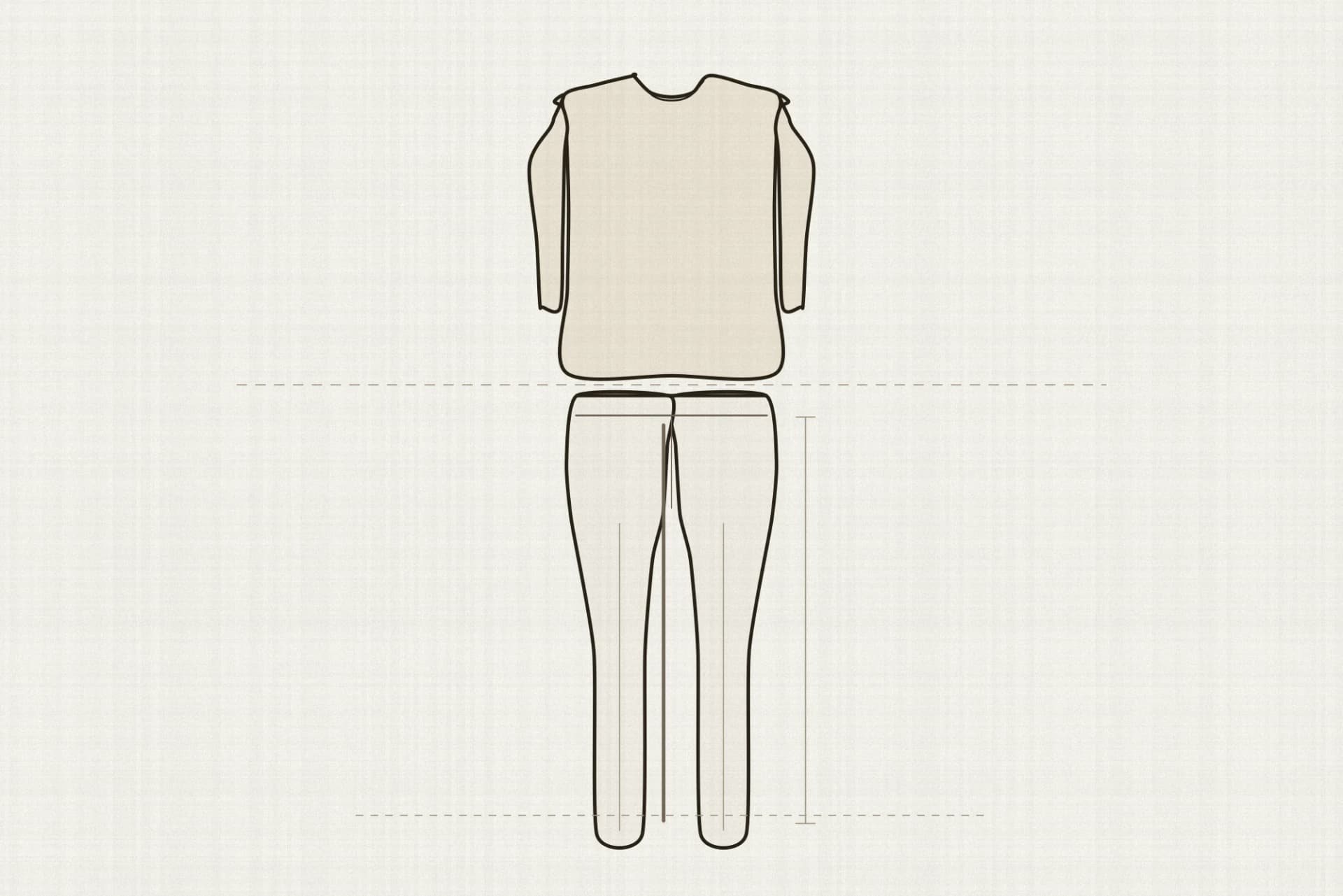
An outfit divided by one horizontal rule at the waist. The knit above the line is drawn plain, while the trouser below it carries a heavy inside-leg line, a measuring bracket and a dashed hem rule.
Petite Fit

Petite on the Bottom, Regular on Top

Nobody is uniformly petite. Plenty of readers are petite in the leg and standard through the body, or the reverse, and buying both halves from the same rack serves neither. The mixing strategy has quiet support in the published sizing of several researched ranges. This piece shows where, and where it fails.

8 min read

More on fit

  1. Which Petite Ranges Say You Will Not Need a Tailor

    Petite Fit8 min read

  2. Fourteen Petite Ranges Publish Nothing About the Cut

    Petite Fit9 min read

  3. Reading a Blazer Before You Try It On

    Petite Fit7 min read

  4. Hem Lengths: The Four Decisions That Matter

    Petite Fit6 min read

  5. How to Layer Without Losing Four Inches

    Proportion9 min read

  6. Knitwear Scale: Chunky Without the Bulk

    Proportion6 min read

  7. Shoe Shapes That Keep the Line Long

    Proportion5 min read